Fragrance Concentrations: Your 2026 Perfume Strength Guide
What are fragrance concentrations, and how long does each one last?
Fragrance concentrations measure the percentage of aromatic compounds in a perfume formula relative to alcohol and other carrier solvents. That single ratio determines how long a scent stays on your skin, how it opens, and how it evolves over hours of wear.
The industry organizes perfume strength levels into four primary categories:
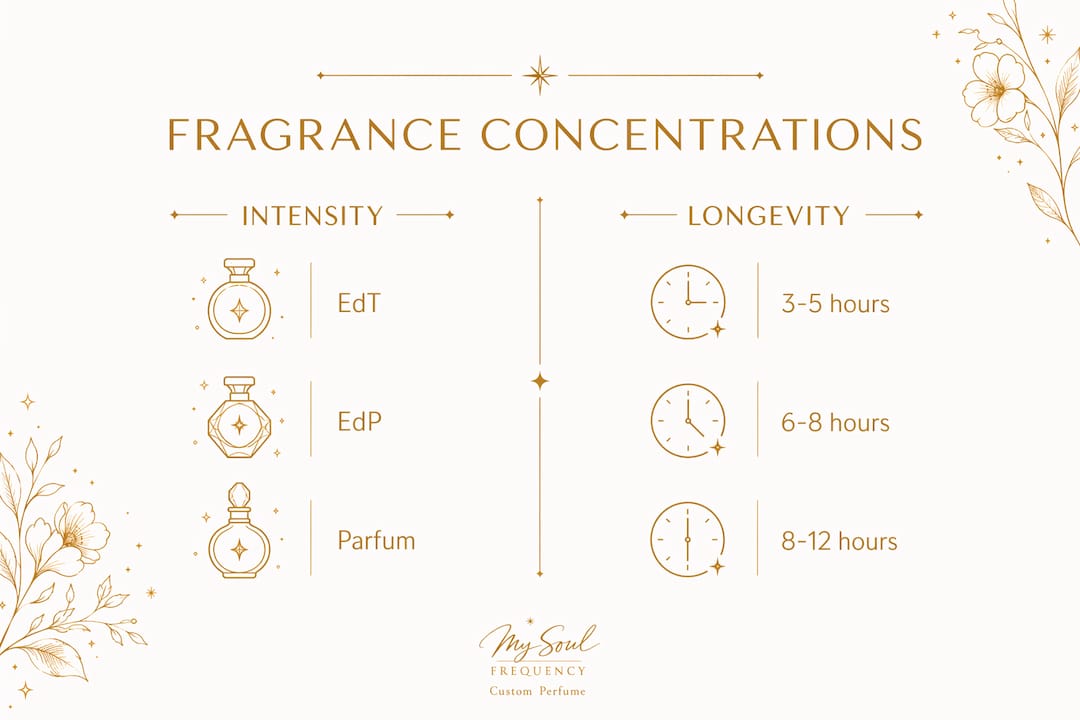
Eau de Cologne (EdC): 2–5% aromatic compounds, lasting roughly 2–3 hours. Light, citrus-forward, and ideal for a quick refresh.
Eau de Toilette (EdT): 5–15% aromatic compounds, lasting 3–5 hours on most skin types. Bright, versatile, and well suited to daytime wear.
Eau de Parfum (EdP): 15–20% aromatic compounds, lasting 6–8 hours. Richer, more complex, and the most popular concentration for daily wear in 2026.
Parfum / Extrait de Parfum: 20–40% aromatic compounds, lasting 8–12+ hours. Dense, intimate, and designed for longevity over projection.
These ranges shift based on climate, skin type, and where you apply the fragrance. A Parfum worn in humid summer heat will behave differently than the same formula in a dry Colorado winter. Longevity also depends on scent architecture: base notes like woods, resins, and musks anchor a fragrance for hours, while top notes such as citrus and aldehydes evaporate quickly regardless of concentration. My Soul Frequency™ builds this understanding into every custom formulation, letting you choose your wear time as part of the creation process itself.
How concentration shapes intensity, projection, and sillage
Higher concentration does not automatically produce a louder scent. This is the most persistent misconception in perfumery, and understanding it changes how you shop.
Projection depends on alcohol content and the volatility of aromatic molecules, not on the oil percentage alone. Because Eau de Toilette carries more alcohol, that alcohol evaporates rapidly on application, launching scent molecules into the surrounding air. The result is an assertive, room-filling opening. A Parfum, by contrast, contains far less alcohol relative to its oil load. It clings to the skin, creating what perfumers call a personal “scent bubble” — intimate, dense, and long-lasting but close to the body.
Sillage, the trail a fragrance leaves as you move, is shaped by base notes, fixatives, and skin chemistry working together. Concentration influences sillage but never controls it exclusively. A resinous EdT with Ambroxan can project further than a woody Parfum built on slow-evaporating musks.
Perfumers also restructure the entire scent pyramid when moving between concentrations. An EdT version of a fragrance typically foregrounds volatile top notes for an immediate, refreshing impression. The EdP version of the same scent reshapes around heart and base notes, producing a different texture and focus entirely. You are not simply getting a stronger version; you are getting a different expression.
Pro Tip: If you want others to notice your fragrance from across the room, a well-formulated EdT with bright, volatile top notes often projects more assertively than a Parfum. If you want a scent that feels like your own skin amplified, Parfum delivers that intimacy with far greater staying power.
How to choose the right concentration for your lifestyle
Occasion, environment, and personal chemistry all shape which perfume strength level serves you best. Matching concentration to context is where the real art of wearing fragrance lives.
Daytime and professional settings: EdT provides moderate projection without overwhelming a shared office or meeting room. Its lighter character reads as polished rather than powerful.
Evening and special occasions: EdP or Parfum rewards the atmosphere. Richer base notes develop beautifully over a dinner or event, and the longevity means no reapplication.
Warm weather: Heat accelerates evaporation, making a heavy EdP feel overwhelming. EdT or a light EdP stays fresh without becoming cloying.
Cool and dry climates: Lower temperatures slow diffusion, so a denser Parfum or EdP carries the scent further and lasts longer on cold skin.
Layering: Lighter concentrations blend more forgivingly. Applying an EdT to hair and clothing over a Parfum on pulse points creates a nuanced, multi-dimensional sillage.
Price tracks concentration. Parfum costs more per milliliter because it contains more raw fragrance material, but it also requires far fewer sprays per application, making the cost-per-wear calculation more favorable than it first appears.
Choosing a fragrance concentration is not about picking the strongest option. It is about matching the scent’s behavior to the life you are actually living: the rooms you walk into, the hours you need it to last, and the impression you want to leave behind.
Testing directly on your skin remains the most reliable method for selecting the right concentration; explore options like those at Fragrance | Jeffi Inc to find what truly suits your personal chemistry. Strip tests and bottle sniffs tell you almost nothing about how a formula will perform on your specific body chemistry over six hours of wear. My Soul Frequency™ supports this decision by letting you select your preferred wear time, Eau de Toilette, Eau de Parfum, or Parfum, as part of the numerology-based formulation process, so the concentration is chosen with intention rather than guesswork. You can also explore fragrance matching by occasion to refine your selection further.
How your skin chemistry transforms any concentration
Skin chemistry acts as the final ingredient in every fragrance, reshaping how a concentration expresses itself uniquely on each wearer. Two people can apply the same EdP and experience entirely different longevity, projection, and scent character.
Personal factors that alter fragrance performance include:
Skin moisture: Moisturized skin holds fragrance significantly longer than dry skin, which absorbs and dissipates scent molecules faster.
Skin type: Oily skin extends wear time naturally, often allowing an EdT to perform with the longevity typically expected of an EdP.
Skin pH: Acidic or alkaline pH shifts the way aromatic molecules bind to the skin surface, changing both scent character and duration.
Diet and hydration: What you eat and drink influences your skin’s natural chemistry, subtly altering how a fragrance smells on you specifically.
Climate and temperature: Warm skin amplifies projection; cool, dry conditions accelerate evaporation and reduce wear time.
This is precisely why your body chemistry can make a friend’s signature scent smell completely different on you. My Soul Frequency™ addresses this directly. Each perfume is mathematically derived from your date of birth through a proprietary numerology-based algorithm, producing a formula calibrated to your personal life matrix rather than a generic aromatic profile. The result is a fragrance that blossoms into a highly personal variation, one that works with your chemistry rather than against it.
Why concentration alone does not determine fragrance quality
Fragrance quality depends on formulation, not on the percentage printed on the box. A well-composed EdT built around rare naturals and precise molecular architecture can outperform a poorly structured Parfum with a higher oil load but an unbalanced scent pyramid.
Marketing terms like “Intense,” “Extreme,” or “L’Absolue” are not regulated concentration designations. They signal a flanker, often a reformulated version with heavier notes like leather, oud, or amber added to shift the scent profile. Always check the actual EdT or EdP label on the packaging to know the true concentration. The International Fragrance Association (IFRA) adds another layer of complexity: raising a formula’s concentration proportionally increases every restricted ingredient in the finished product, which can force significant reformulation to maintain compliance. A higher concentration is not simply “more of the same.”
My Soul Frequency™ approaches quality through bespoke mathematical design. Every formula is individually handcrafted, never pre-made, using paraben-free and phthalate-free ingredients made in the USA. The concentration you select, whether EdT, EdP, or Parfum, is integrated into the numerology-based formulation from the start, not applied as an afterthought. Explore the custom perfume creation process to understand how this works in practice.
Key Takeaways
Fragrance concentration sets longevity and scent character, but projection, formulation quality, and your skin chemistry determine the full experience.
Point | Details |
Concentration sets longevity | EdT lasts 3–5 hours, EdP lasts 6–8 hours, and Parfum lasts 8–12+ hours on most skin types. |
Higher concentration, less projection | Parfum creates an intimate scent bubble; EdT projects further due to higher alcohol content. |
Skin chemistry is the final variable | Dry skin reduces wear time; oily skin extends it, sometimes matching a full EdP’s longevity from an EdT. |
Quality lives in formulation | A well-structured EdT can outperform a poorly composed Parfum regardless of oil percentage. |
Match concentration to context | EdT suits daytime and warm weather; EdP and Parfum reward evenings, cool climates, and special occasions. |
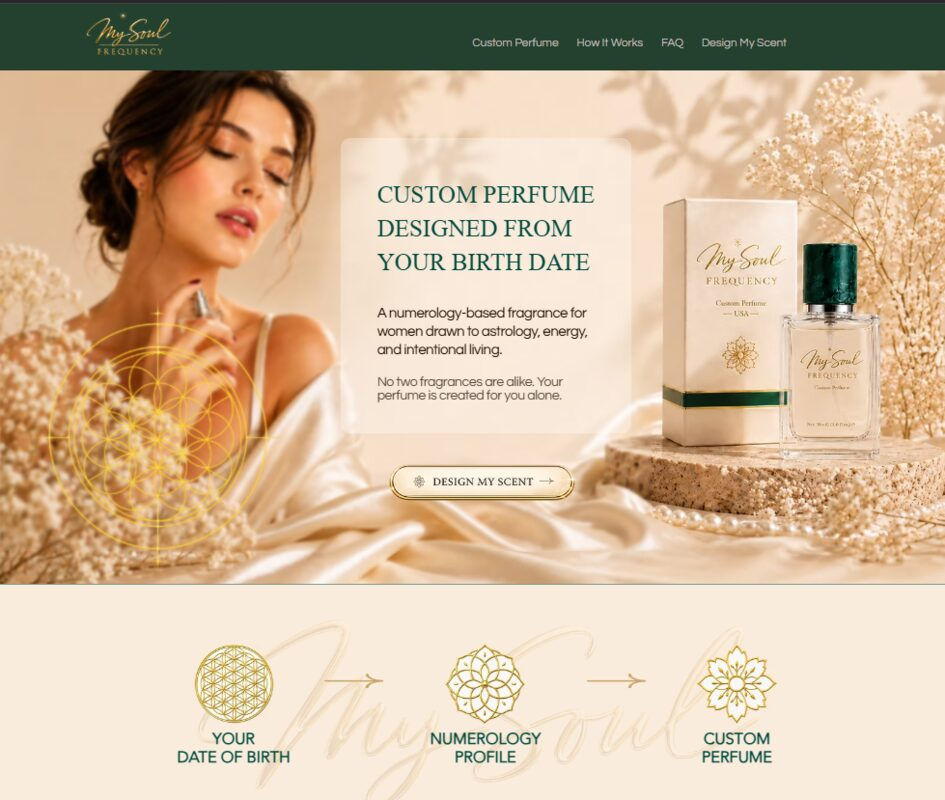
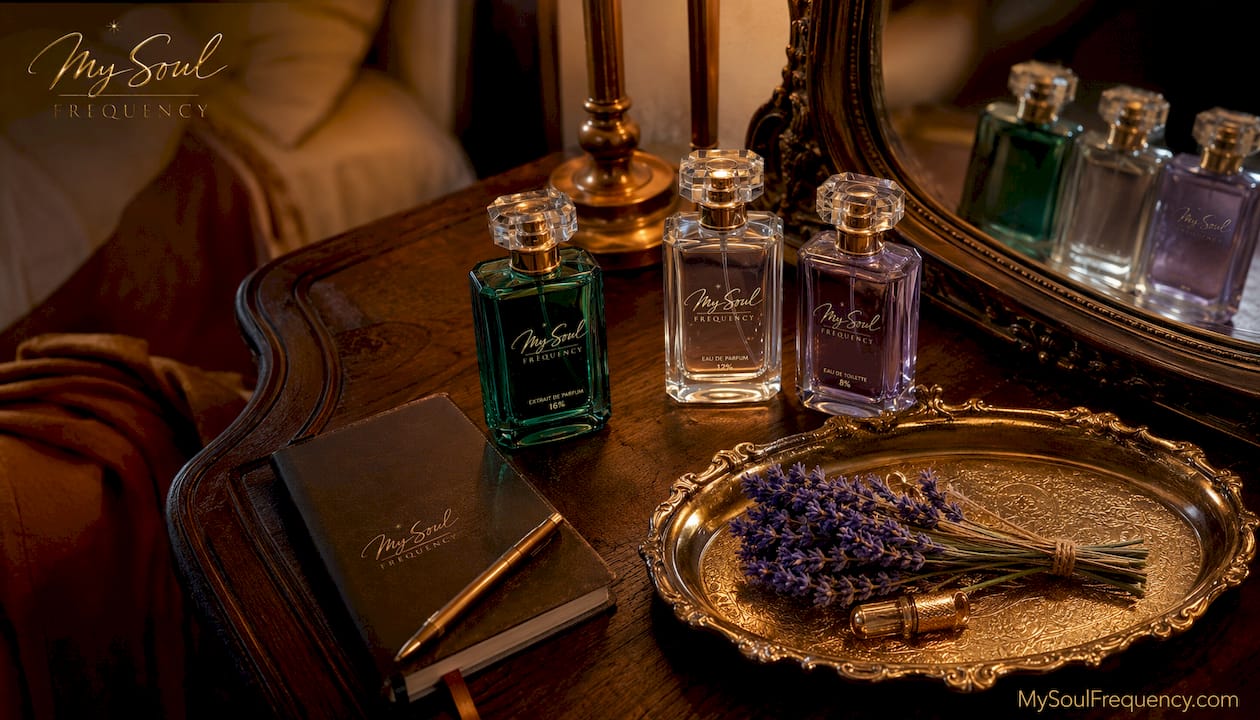
A custom numerology perfume from My Soul Frequency™, available in Eau de Toilette, Eau de Parfum, and Parfum concentrations.
Your fragrance concentration is not a detail to leave to chance. At My Soul Frequency™, every perfume is mathematically formulated from your date of birth, with your chosen concentration built into the formula from the first calculation. Starting at $49.99, backed by a 30-day money-back guarantee, and available in 15ml, 30ml, 50ml, and 100ml sizes, each scent is handcrafted in the USA for one person only: you. Discover your numerology-based custom fragrance and experience what it means when a perfume is designed to resonate at your exact frequency.
Recommended